


Surfing Republica - Old is cool with Roberto Miranda

Roberto Miranda tells us about his anecdotes as a surfer and how he got started in this sport.
 Surfing Costa Rica - Roberto Miranda, pioneer of Costa Rican surfing.
 Surfing Costa Rica - Roberto Miranda, pioneer of Costa Rican surfing.
Today, talking about surfing in Costa Rica without knowing our true roots is quite daring; surfing in the years when it all began has true warriors, with stories to highlight.
That's what we'll try to do in this new section we've called "Old is Cool." This time, we bring you a character with a great story and, without a doubt, a pioneer of Costa Rican surfing. We're talking about Roberto Miranda , who in this article will share some of his experiences from his surfing days.
When did you start surfing and why?
That was over fifty years ago, in the late sixties. Now, at 69 years old, I continue to surf, and I still do it with a shortboard. I've always been known as an adventurer who loves challenges.
It all started because one day I saw some Californian surfers in Boca de Barranca. They had arrived on a sailboat and I immediately became hooked on surfing, and I still am to this day and hope for many more years, as long as my body holds out, because the passion is there.
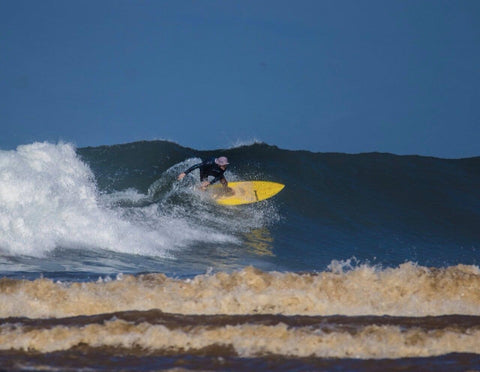
Surfing Costa Rica - Roberto Miranda surfing Boca de Barranca.
What was surfing like back then?
It was completely unknown to us, so we had to experience everything on our own. The boards had a single, fixed fin, leashes hadn't been invented yet, we didn't have wax and had to use candle wax, and to get it to stick we had to scrape off the board's shine. We wore swim trunks, now popularly known as "thongs," and rash guards didn't exist either—in other words, surf equipment didn't exist.
An interesting fact about leashes is that since they didn't exist, we could lose our boards and we were afraid of sea creatures (sharks), but even with so many difficulties it was fascinating; we never imagined that we would become so many surfers and that it was possible to make a living from surfing.
What difficulties did you have surfing at that time?
The biggest challenge was getting to the beach; for example, the closest one was Boca de Barranca, and it required a five-hour drive, passing through the center of every town on a route that involved Heredia, Alajuela, Tacares, Grecia, Sarchí, Naranjo, Palmares, San Ramón, then Cambronero, you'd get to Esparza and finally Barranca, and we had to do that every weekend; it was truly a marathon, but the passion for surfing made it worthwhile.
 Surfing Costa Rica - Roberto Miranda surfing Boca de Barranca.
 Surfing Costa Rica - Roberto Miranda surfing Boca de Barranca.
Tell us a couple of anecdotes from those days?
Of course, there are many stories. For example, once in 1973, someone told me that the sea in Jacó was very rough and that it was possibly a good place for surfing, so I decided to go and investigate and bring my surfboard. But since I got off work at noon, I had to leave San José with my wife and my first child, who was just a few months old. When we got to the ferry crossing on the Tárcoles River, it had already stopped running and wouldn't resume service until the following morning. After signaling to try and get the ferry to come for us, and failing, I suggested to my wife that we sleep in the car. She refused and said we should go to a hotel, but there weren't any hotels along the way, and the only solution was to go all the way back to San José. Then I made one last decision to continue the journey, and that was to cross the Tárcoles River at night by swimming, and when I got to the other side of the river the raftsman scolded me for doing such a crazy thing and informed me that the river was full of crocodiles and luckily he did us the favor of going to pick up the car with the raft and cross the river safe and sound.
Another anecdote I can share is from 1980, which was my first trip to surf Pavones. It was a very long journey, crossing the Cerro de la Muerte mountain range on difficult roads. When we were about ten kilometers from Pavones, maybe a little more, our car got stuck. Despite being a 4x4, a huge mudslide prevented us from moving forward, and we had to climb out the windows and walk for about five hours to reach Pavones. There were no hotels back then, so we had to sleep for three nights on the porch of a house where they very kindly let us put our things and spend the nights. Nevertheless, we were able to surf world-class waves on a trip I'll never forget. Regarding the car, we got it out a few days later with a bulldozer. My adventure companions on this trip were Álvaro Vizcallino and Marco Bonilla.
How have things changed to this day?
From the seventies to the present, Costa Rica is very different. Today, access to practically all coastal regions of our country is easier. Now there are hotels, restaurants, gas stations, bridges that cross rivers, and tourist companies that take you to surf spots that are not accessible by land.
We have manufacturers of very good quality surfboards, accessory shops, and if you need a surf guide or instructor, you can easily find one. One of the things that impresses me most about the changes in Costa Rica, and I'm very happy for those who decide to make it happen, is that for many years now, surfers who want to build a life through surfing have been able to do so, because there are study and work opportunities in the coastal areas of the country where there is tourism.

Surfing Costa Rica - Roberto Miranda surfing on a Costa Rican beach.

What do you think should exist in national surfing today?
Surfing has become a very important industry for the Costa Rican economy, creating jobs for both surfers and non-surfers. These jobs should be filled by Costa Ricans or legal residents, not by adventurous foreigners who are just passing through and who don't contribute to the Costa Rican Social Security Fund (CCSS) or pay taxes. We must report these cases, and by doing so, we are protecting our rights and the country's economy.
Give us a message for the new generations.
We live in a privileged country with the possibility of surfing year-round, whether on the Pacific or the Caribbean coast, with world-class surf spots and beautiful beaches and national parks with lush vegetation. It has taken a lot of effort for Costa Ricans to get where we are; let's continue to take care of it and demand that those who visit us and those who come to live in Costa Rica help us protect it as we Costa Ricans have done.
Written by: Enrique Hernández
General Management: Marco Montero

2 comments
UN HERMOSO REPORTAJE, PERO YO QUE HE COMPARTIDO MUCHOS SITIOS CON ROBERTO DESDE LOS 80’, SON MUCHAS LAS ANECDOTAS QUE TENEMOS..
ROBERTO ES UN ATLETA DE ALTO RENDIMIENTO, ES LA PERSONA MAS AVENTURERA, DEPORTISTA A TODO DAR, SUPER VALIENTE Y EXC SURFER. AMANTE DE LA NATURALEZA, DEL MAR SUS OLAS Y ENAMORADO DE COSTA RICA Y SU GENTE. ES MUY PASIVO, TRANQUILO, Y MUY ACUANIME, NUNCA LE HE ESCUCHADO HACER ALGUNA CRITICA MAL INTENCIONADA, SIEMPRE MUY HONESTO Y MUY RESPETUOSO. AMANTE DE SUS HIJOS, UN PADRE EJEMPLAR, Y COMO AMIGO UN 10
Es importante este reportaje para conocer a uno de los primeros surfeadores de Costa Rica, que todavía se encuentra compitiendo, son pocos los de esa época que están activos. Roberto Miranda es un ejemplo de la constancia y dedicación al deporte. Saludos cordiales que tengas